|
Introduction
Tides rise and fall and also flow along our coast. We will deal with these as separate items, but first why do we have tides at all? Is the Earth breathing or maybe it’s on a slope? Maybe not? Read on. Gravity is the force, which produces the tidal effect. Not the Earth’s gravity, but the gravitational pull of both the Moon and to a lesser extent the Sun. |
 |
 |
Everything on Earth is subject to the Moon’s gravitational effect, but most objects are fixed or solid and cannot move or be sucked toward the Moon. Maybe the great brains will get together when our fossil fuel runs out, to see if they can harness this incredible natural power that can effortlessly drag all the waters of the English Channel, zillions of gallons, on average about twelve miles and it does this twice every day! Pretty impressive if you ask me.
The seaman can use this force, or not, but one thing is certain, he can do nothing about it!
What happens?
As the Moon orbits the Earth, its gravity sucks water towards the Moon. This creates a rise in the water level under the Moon. Tidal rise.
The Moon is on the move and we are spinning around, so this lump of higher water gets pulled around the Earth. Tidal flow.
This is a simple way of understanding what happens.
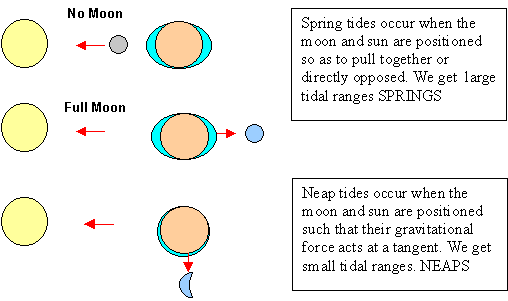
The Moon orbits the Earth about every 28 days and we spin around once every 24 hours.
The tides I’m afraid do not happen quite that regularly. The Sun sticks its oar in and mucks up the pattern.
In northern Europe we get two high tides and two low tides every 24 hours (ish). The times of these high and low waters are constantly progressing, (high tide gets later every day). The time between high and low water averages out at a few minutes longer than six hours apart. The tides also constantly swing from Neaps to Springs and back, so the heights of these high and low tides are always changing too.
At a particular port, Spring and Neap high waters always occur at the same times.
For example, in Plymouth, Spring high waters are always around six a.m. and six p.m. Neap high waters are around lunchtime and midnight.
At Southampton though, Spring high waters are at lunch time and Midnight and Neaps are around six a.m. and 6 p.m.
The above is all very interesting, but all the seaman needs to know is how high is the tide, how fast is it going and where is it going?