Introduction
Defining "Good Seamanship" is not easy. There are no examples of it because if a skipper is applying good seamanship, nothing goes wrong! I could give you a hundred examples of bad seamanship!
Some of the virtues required for good seamanship are; planning, forethought, consideration for others, knowledge and lots of experience. The sure way of gaining all this is to use lots of bad seamanship. Learn from your mistakes or preferably other people’s!
There is a general misconception that "boating is easy; anyone can do it". That’s almost true. Anyone can do it; badly and dangerously!
In this module we will cover,
- Parts of the Boat
- Boat safety equipment
- Personal safety
- Distress situations
- Fog safety
- Anchors
- Mooring
- Knots
| SAILS
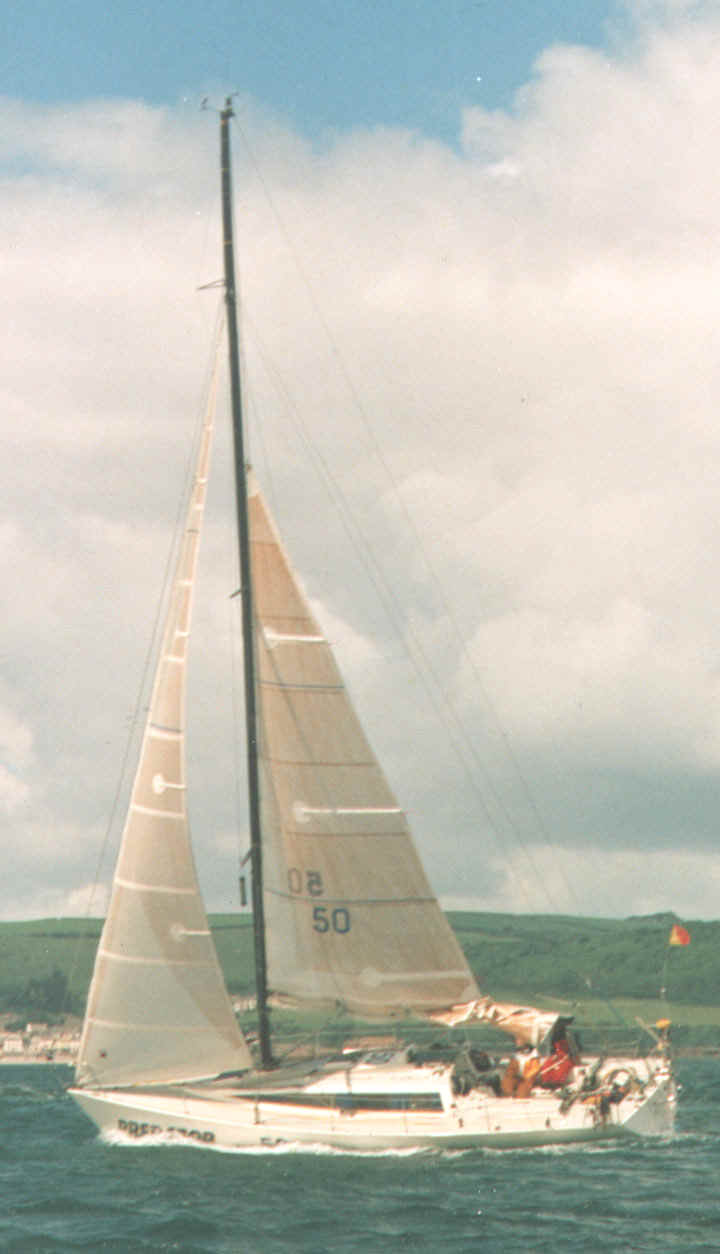
Again this is huge subject and I will not cover it in depth. The most common form of sailing yacht around today is the Bermudian sloop. It is a simple, two triangular-sailed affair. A mainsail and a foresail. Within this group there is again variation. The boat on the right is a fractional rig, where the forestay and therefore the foresail does not reach the masthead.
|
 |
| This is a is a masthead-rigged Bermudan
cutter. She has an extra staysail for better windward
performance and strong wind sailing.
Both boats have reefed mains’ls. As the wind increases, we must reduce the size of the sails, both for optimum performance and safety.
|
 |
|
Spinnakers are the big colourful sails at the front! They are symmetrical. Cruising chutes are similar, but are asymmetric. They are used in light to moderate winds when sailing off the wind. They are great fun, but hard work. We flew the one below through the Menai Strait in North Wales and didn’t take it down until it blew out (i.e. ripped) off Jura in the Scottish Islands. A great day! |
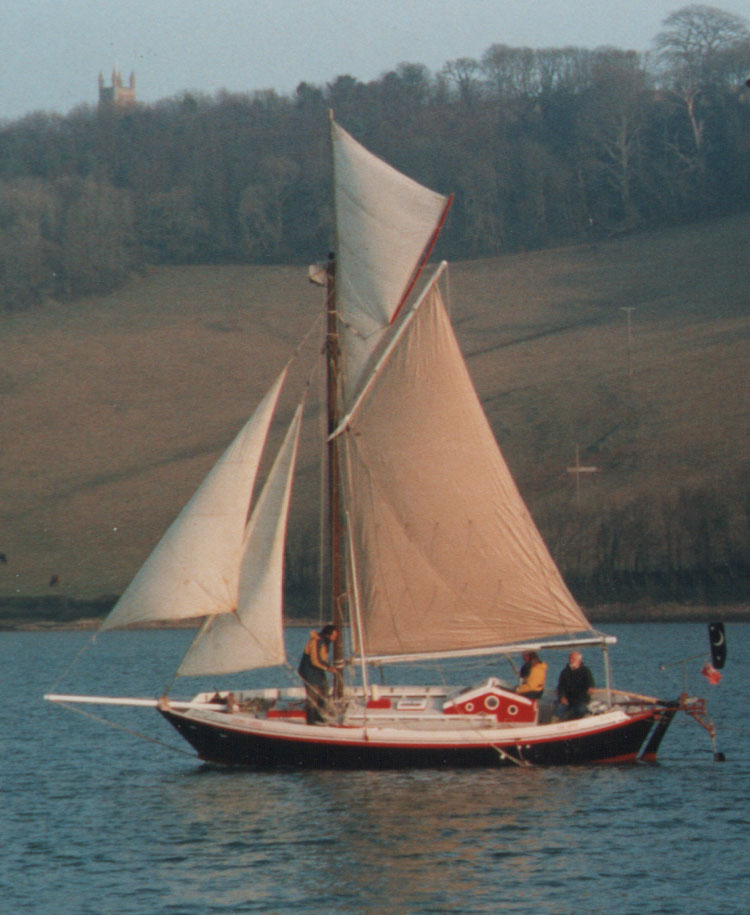 This is Tops’l "Gaff cutter" under full sail. The mains’l has an upper boom the "gaff". Isn’t she lovely? What tack is she on? |
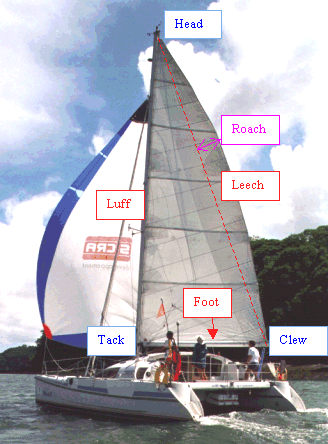
I can’t think of anything much that I would rather be doing than sailing "Flat out with the kite up!" But let’s have a think about the names of parts of the sail.
The luff, leech and foot are the three sides. The head, tack and clew are the three corners.
The area of the sail between the hypotenuse and the leech is called the roach. There are battens parallel with the boom to force the sail to hold its aerodynamic shape. These can be of wood, GRP or commonly these days carbon fibre.
All triangular sails use the same names for the different sides and corners.